
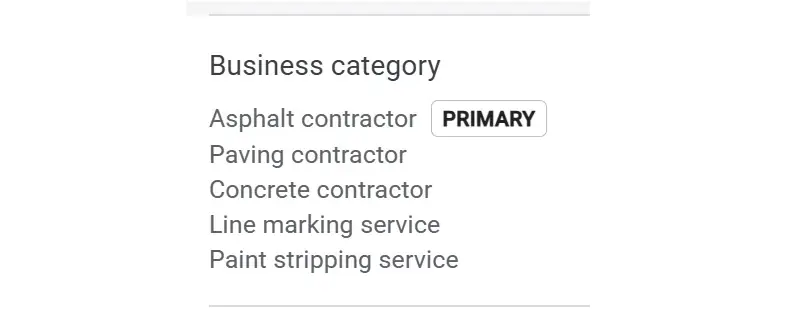
If a competitor is outranking you on Google Maps, there is a good chance your Google Business Profile categories are part of the problem. Not broken. Just wrong enough that Google is sending your jobs somewhere else.
The fix takes two minutes. Here is how to do it right.
Why Categories Matter More Than Most Contractors Realize
Your Google Business Profile category is not a tag or a label. It is one of the most important signals you send to Google about what your business does and who should find you.
When someone searches for an asphalt contractor near them, Google looks at your category to decide whether to show your profile. Get it wrong and you become invisible for the searches that matter most. Get it right and you start showing up in front of customers who are actively ready to hire.
A Google Business Profile can have up to ten categories. One is your primary, which carries the most weight in local search rankings. The remaining nine are secondary categories that help define the full range of your services.
Set Asphalt Contractor as Your Primary Category
Your primary category does the heavy lifting. For the vast majority of companies in this trade, that primary category should be Asphalt Contractor.
It is the most specific, most relevant description of your core work, and it tells Google exactly what you do. If your primary category currently says something broader or off the mark, this is the single most important change you can make today.
Add Paving Contractor as Your Secondary Category
Next, add Paving Contractor as a secondary category. Plenty of your customers search using the word paving rather than asphalt. Adding this category captures that audience without pulling focus away from your primary.
These two together, Asphalt Contractor and Paving Contractor, cover the core of what most companies in this trade actually do.
Additional Categories: Only If Your Website Backs Them Up
This is where most contractors get themselves into trouble. Google lets you add up to ten categories, so the temptation is to load up on every category that sounds close. Do not do that.
Here is the rule. Only add a category if your website has real content supporting that service. Google cross-references your profile against your website. If you claim a service your site never mentions, at best it does nothing, and it can work against you.
These are the additional categories worth considering, each only when your site has a page or section that backs it up:
Concrete Contractor. Add it if you pour concrete driveways, slabs, or flatwork and you have a page describing that work.
Line Marking Services. Add it if you stripe parking lots or mark roadways, supported by photos or a service page.
Snow Removal. A solid seasonal add, but only if you actually run snow removal and your site says so.
Earthworks Company. Relevant if you handle grading, land clearing, or site prep, with content to match.
Excavation Company. Add it if excavation is part of your workflow and your site demonstrates it.
Asphalt Mixing Plant. Highly specific. Only applies if you operate your own plant, and your site should make that clear.
If your site has nothing about it, leave it off. Google cross-references your profile with your website.
A Word of Caution on Overloading
Stuffing your profile with categories you do not really serve is one of the fastest ways to confuse Google about what your business is. It can dilute the strength of your primary category and, in some cases, put your profile at risk. Lean and accurate beats long and padded every time.
The Bottom Line
Go into your Google Business Profile right now and check your primary category. If it does not say Asphalt Contractor, that is your first fix. Everything else in local SEO builds on top of it.